
Vitamin K Deficiency Is Trending. Here’s the Formulator’s View on Vitamin K2
Google Trends is showing a spike in searches for vitamin K deficiency.
That usually means one of two things: either people are curious, or people are confused.
At Balterra, we care about both.
Vitamin K is not a trendy nutrient. It is not a new discovery. And it should not be reduced to a fear-based headline.
It is a real nutrient with real biological roles. But as a formulator, I also want to add something that often gets missed:
The form of the nutrient matters.
The source matters.
The ingredient choice matters.
That is especially true with vitamin K2.
First: what does vitamin K do?
Vitamin K is best known for its role in normal blood clotting.
Your body uses vitamin K to help activate proteins involved in clotting. Without enough vitamin K, the body can have a harder time forming clots properly.
Vitamin K also plays a role in bone health. Some vitamin K-dependent proteins are involved in bone metabolism, which is one reason vitamin K often shows up in conversations about long-term skeletal health.
So, in plain English:
Vitamin K helps support normal clotting and healthy bones.
That is the simple version.
Why is vitamin K deficiency being searched right now?
A major reason people are searching for vitamin K deficiency is the conversation around newborn vitamin K deficiency bleeding, sometimes called VKDB.
As a parent of four, I understand why topics involving newborns can feel emotional fast. When something involves a baby’s health, people want clear answers, not fear, pressure, or internet confusion. That is why this topic deserves extra care.
Newborns are born with very low vitamin K stores. That is why vitamin K is commonly given shortly after birth as a shot. This is medical care for infants and should be discussed with a pediatrician or healthcare provider.
That is also very different from an adult taking a vitamin K2 supplement.
This distinction matters.
A newborn vitamin K shot is not the same thing as a daily adult supplement. A vitamin K2 supplement is not a replacement for medical care.
A trending headline should not be used to blur those lines! Period.
Vitamin K1 vs. Vitamin K2: what’s the difference?
Vitamin K is not just one thing.
There are different forms, including:
Vitamin K1, which is commonly found in leafy green vegetables.
Vitamin K2, which includes forms called menaquinones. One of the most common and researched supplemental forms is MK-7.
From a formulation standpoint, this distinction matters because K2 as MK-7 is often selected for adult supplement formulas designed around bone-health support.
That is why Balterra’s Vitamin D3 + K2 uses MenaQ7® vitamin K2 as MK-7 from Gnosis by Lesaffre. MenaQ7®: Natural Pure and European-produced Vitamin K2
Why Balterra uses MenaQ7® vitamin K2
When I formulate, I am not only asking, “What nutrient should be in this product?”
I am asking:
What form?
What dose?
What source?
What evidence?
What does the ingredient actually bring to the formula?
For Balterra’s Vitamin D3 + K2, we chose MenaQ7®, a branded vitamin K2 ingredient from Gnosis by Lesaffre.
Their MenaQ7® literature describes it as a natural vitamin K2 as MK-7 ingredient produced through fermentation, and notes that it has been used as source material in more than 22 human clinical trials.
That matters to me as a formulator because “K2” on a label is not the whole story.
Consumers often see the Supplement Facts panel and assume the ingredient decision is simple. But behind that line is a series of formulation choices.
For vitamin K2, those choices include the form of K2, the source, the purity profile, the stability, the delivery system, and the supplier’s quality standards.
MenaQ7® also emphasizes its MK-7 form, its fermentation-based production, and its high all-trans isomeric purity. Their brochure describes MenaQ7® as having general purity exceeding 97% and 99.8% all-trans K2 as MK-7.
That is exactly the type of detail I want consumers to understand.
Not because every consumer needs to become a formulation scientist but because you deserve to know that someone made those decisions carefully.
Why pair vitamin D3 with K2?
Vitamin D3 and vitamin K2 are often paired because they support related but different parts of bone-health biology.
Vitamin D3 helps support calcium absorption.
Vitamin K2 supports vitamin K-dependent proteins involved in bone metabolism.
A simple way to think about it is:
D3 helps absorb calcium.
K2 helps support the proteins that help put calcium to work.
They do not do the same job. They are not interchangeable. But they can belong in the same formula when the goal is thoughtful bone-health support.
That is the reason Balterra pairs vitamin D3 with MenaQ7® vitamin K2 as MK-7.
Not because pairing ingredients sounds fancy but rather, because the pairing has a purpose.
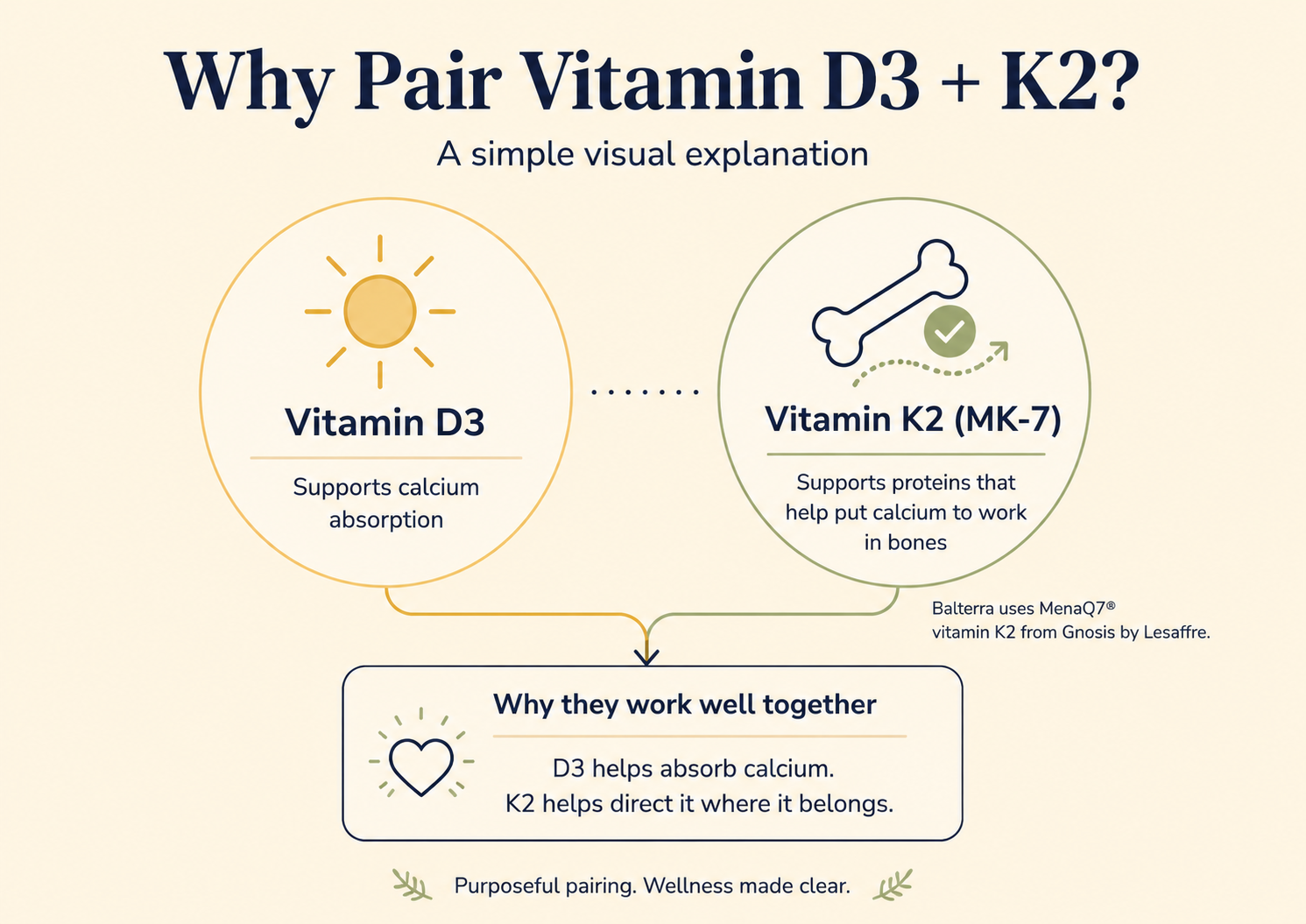
Why pair D3 + K2? Vitamin D3 supports calcium absorption, while vitamin K2 as MK-7 supports proteins involved in helping calcium do its job in bones. Balterra uses MenaQ7® vitamin K2 from Gnosis by Lesaffre.
The formulator’s lens: “active + purposeful pairing”
This is one of the reasons Balterra exists.
The supplement industry has made labels feel complicated. Sometimes people are told to fear the “other ingredients.” Other times they are sold giant proprietary blends that make it hard to know what is actually doing the work.
Neither approach helps consumers.
A better question is:
What is the active ingredient?
Why is it there?
What form is being used?
What is it paired with?
Does the pairing make sense?
For our Vitamin D3 + K2, the answer is straightforward:
Vitamin D3 is included to support vitamin D status and calcium absorption.
Vitamin K2 as MK-7 is included to support vitamin K-dependent proteins involved in bone health.
MenaQ7® is used because the source and form of K2 matter.
That is the Balterra promise:
Active ingredients + purposeful pairing.
Who should be careful with vitamin K?
This is important.
People taking blood thinners, especially warfarin, should speak with a healthcare provider before changing vitamin K intake. Vitamin K can affect how certain anticoagulant medications work, and consistency matters.
Also, if you are pregnant, nursing, managing a medical condition, or making decisions for a newborn, this is a conversation for your healthcare provider.
Supplements are not a substitute for medical care.
The Balterra perspective
At Balterra, we believe wellness should be clear.
That means we do not use trending searches to create panic. We use them as an opportunity to explain.
Vitamin K matters.
Vitamin K2 form matters.
Ingredient sourcing matters.
Pairing D3 and K2 should be purposeful.
And the difference between a newborn medical intervention and an adult bone-health supplement really matters.
Balterra’s Vitamin D3 + K2 was built around that clarity: purposeful ingredients, meaningful forms, and a formulation logic consumers can actually understand.
Because better wellness decisions start with better information.
Final takeaway
Vitamin K deficiency is trending because people are asking questions.
That is a good thing.
But the answer should not be fear. The answer should be education.
Vitamin K supports normal clotting and bone health. Vitamin D supports calcium absorption and bone health. And when paired thoughtfully, D3 + K2 can be part of a smart adult wellness routine.
At Balterra, we chose MenaQ7® vitamin K2 as MK-7 because ingredient quality is not a footnote.
It is part of the formula.
And the formula is the promise.